History of Apple Valley, California


With Timeline of Events

Apple Valley, located in California’s High Desert, has a deep and varied history shaped by Native peoples, pioneers, developers, and Hollywood legends.

Before settlers arrived, Native American tribes including the Serrano, Paiute, and Mojave lived along the Mojave River. These Indigenous communities thrived on its seasonal flows and the resources it provided. In 1776, Spanish missionary Francisco Garcés passed through the area, blazing trails that later became vital travel routes for westward migration. Between 1849 and 1859, more than 13,000 emigrants, traders, and miners traveled the Mojave River Trail through what would become Apple Valley.

The name “Apple Valley” was coined in the 1890s by Ursula Poates, who remarked on the apple trees growing modestly along the river. Though apple farming peaked in the 1920s with award-winning orchards, it declined during the Great Depression due to high irrigation costs and competition from other regions.

In 1910, Dr. Harris Garcelon homesteaded 160 acres of land and founded what would become Jess Ranch. Originally promoted as a retreat for individuals with asthma and tuberculosis, the ranch eventually served as a sanatorium for World War I veterans. After plans for a resort failed during the Depression, Garcelon’s nephew, Stoddard Jess, purchased the property in 1932. Jess, in partnership with neighbor Gay Lewis, turned it into one of the West’s largest integrated turkey ranches. Later, with ample water rights, they added trout farming and opened public fishing lakes under the “Royal Coachman” brand. By the 1980s, the land transitioned into the residential and retirement community known as Jess Ranch.

The transformation of Apple Valley accelerated in 1946 when developers Newton T. Bass and Bud Westlund established the Apple Valley Ranchos Land Development Company. Their goal was to create a model desert community. In 1948, they opened the Apple Valley Inn, a luxury resort that attracted celebrities such as Bob Hope, Marilyn Monroe, and John Wayne. In 1965, Roy Rogers leased the inn and added his name to it, creating a Western-themed attraction complete with horse stables and outdoor cookouts.

Just above the inn, Newton Bass built the Hilltop House in 1957. This modernist residence, designed to impress visiting investors, featured floor-to-ceiling windows, boulder outcrops in the living room, and panoramic desert views. Though damaged by fire in 1967 and neglected for decades, it stood as an icon of Apple Valley’s early vision until its demolition in 2022. A public overlook is now planned for the site.

Other notable landmarks include Dead Man’s Point, a granite outcrop between Apple Valley and Lucerne Valley, named for local legends and known for its dramatic views. It was used as a filming location in the 1950s and once hosted a small Old West-themed attraction. Bell Mountain, northeast of town, rises to nearly 3,900 feet. Settled in the early 1900s, it now draws hikers seeking a challenging climb and wide desert views.

Apple Valley was incorporated as an official town on November 14, 1988. Today, it blends desert serenity with a colorful legacy of ranchers, developers, celebrities, and homesteaders—all of whom helped shape this uniquely American desert community.


Timeline of Apple Valley History

  • 1849–1859 – Mojave River Trail sees heavy pioneer travel.
  • 1890s – Ursula Poates names the area “Apple Valley.”
  • 1910 – Dr. Garcelon establishes a health-focused homestead (Jess Ranch).
  • 1912 – Homesteaders begin settling the Bell Mountain area.
  • 1932 – Stoddard Jess buys the ranch; turkey farming begins.
  • 1946 – Apple Valley Ranchos Land Development Company is founded.
  • 1948 – Apple Valley Inn opens to attract investors and celebrities.
  • 1955 – Dead Man’s Point used as a movie location.
  • 1957 – Hilltop House constructed by Newton T. Bass.
  • 1965 – Roy Rogers leases and rebrands the Apple Valley Inn.
  • 1977 – Jess Ranch ceases turkey operations.
  • 1986 – Residential development begins at Jess Ranch.
  • 1988 – Town of Apple Valley officially incorporates (November 14).
  • 1994 – Jess Ranch trout farm closes.
  • 2003 – Restoration efforts begin on Apple Valley Inn.
  • 2022 – Hilltop House is demolished; the site is slated for a scenic overlook.

Apple Valley, CA

Apple Valley is located in the Victor Valley of San Bernardino County, California, and was incorporated on November 14, 1988. The town of Apple Valley is located 10 miles east of neighboring Victorville, 37 miles (60 km) south of Barstow and 46 miles (74 km) north of San Bernardino through the Cajon Pass.

Historic Victor Valley Wagon Roads

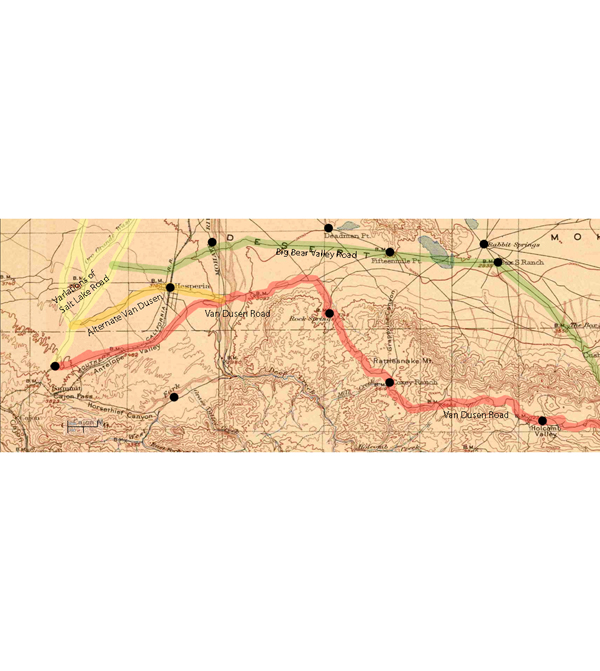
Primary regional road network — USGS 1901

Not all-inclusive, this 1901 map shows basic transportation routes between the Cajon Summit on the west and east from there through either the San Bernardino Mountains or Lucerne Valley to where the two roads meet in the Big Bear Valley.

This map below was made in 1883 and shows an earlier and geographically expanded version of the routes.
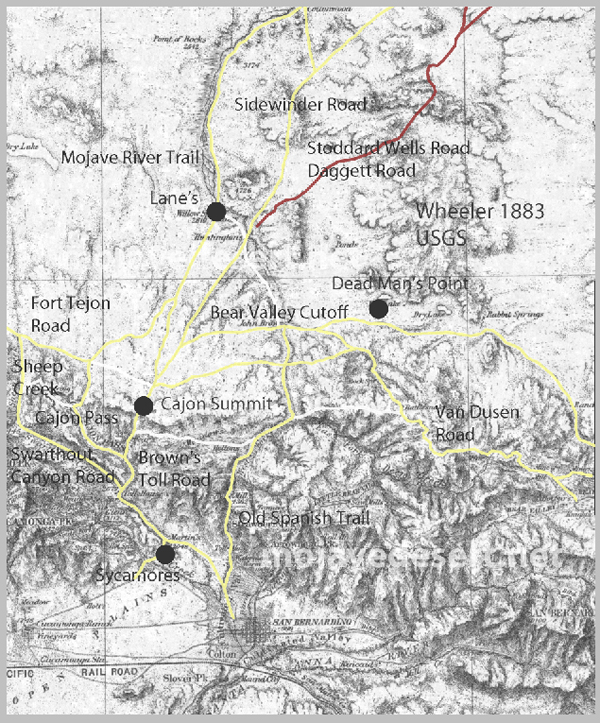
1883 map of route network in the upper Mojave River region (note; no railroad)

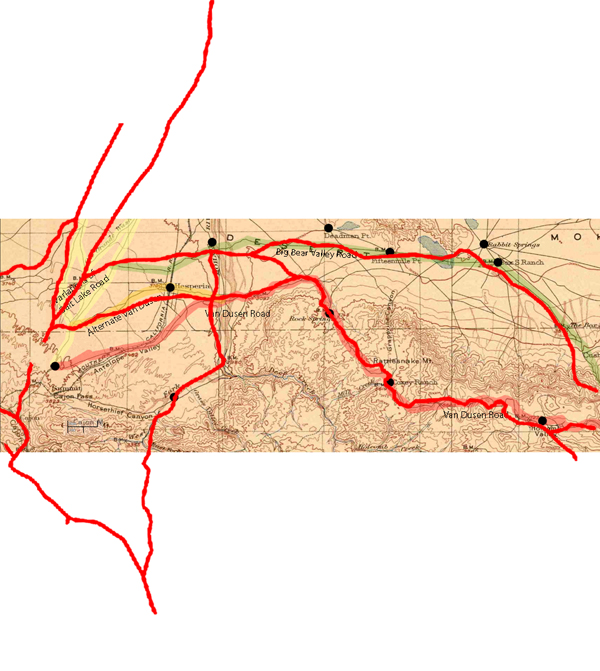
The 1883 map is more inclusive and contains a couple of items I want to keep track of. There are differences but the road segments look about the same.

I made a copy of the 1883 roads layer and made it red to stand out better.
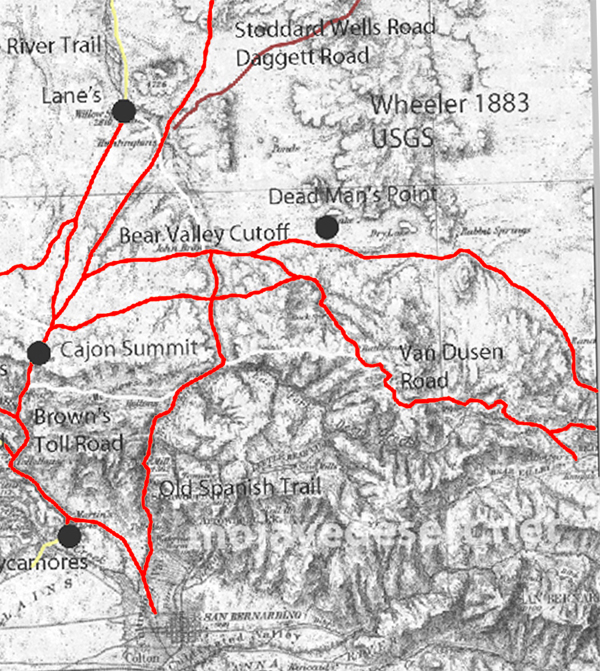
There are some nuances between the two maps, and right now the Oro Grande Wash area seems considerably off, fiddling with it some I can get a better fit–but not at these rates. The 1901 would be the more accurate depiction of what went on out there even if it were 35 years or so after the fact.
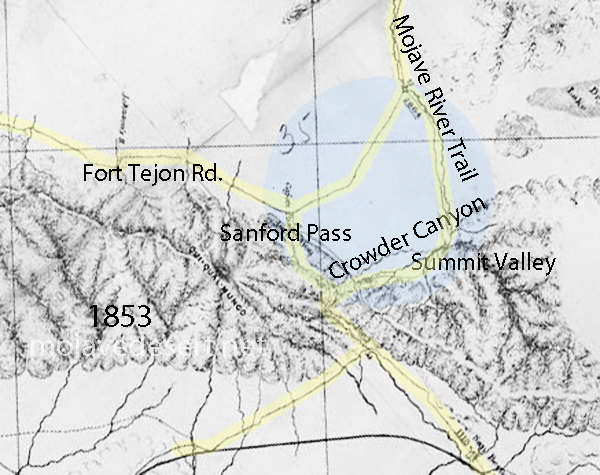
Williams USGS survey map 1853

Note that in the above map the variations of trails from across the valley leading to the Cajon Summit seem not to have been developed at this time and instead the trail along the Mojave River is shown.
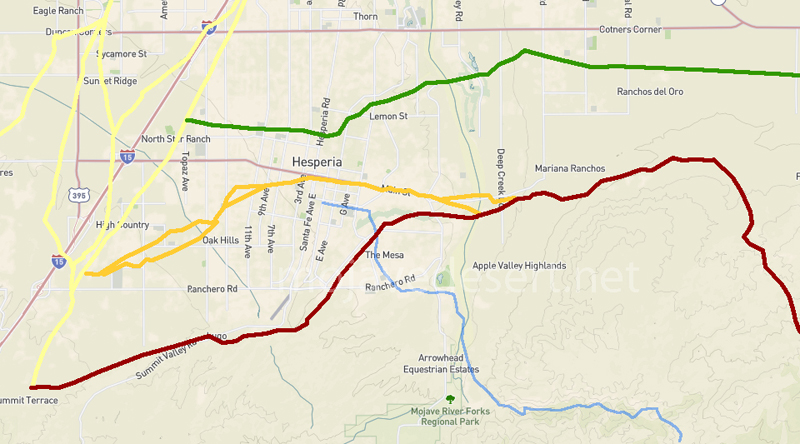
1901 trail routes transposed over modern street map through Hesperia

Victor Valley Crossings

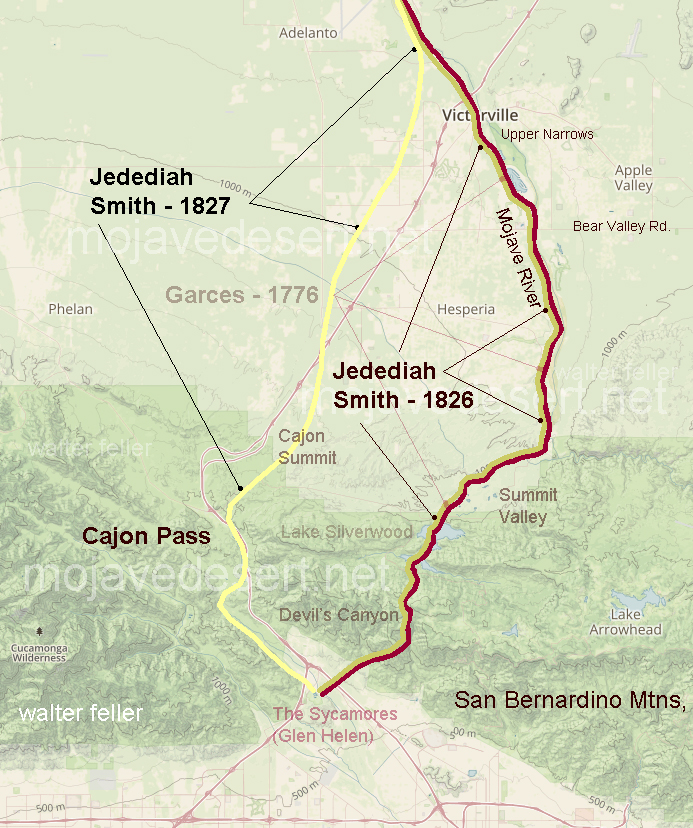
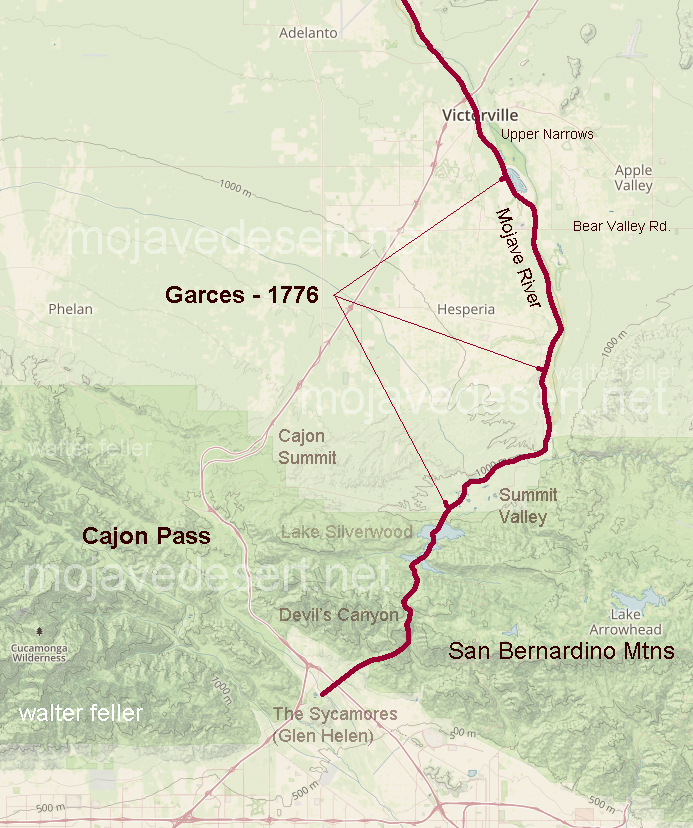
Fr. Francisco Hermenegildo Tomás Garcés (April 12, 1738 – July 18, 1781) was a Spanish priest who crossed the Mojave Desert in 1776. This map shows his route across the Victor Valley. Following the Mojave River after crossing at Oro Grande, he walked through downtown Victorville, bypassing the rocky narrows and connecting with the river near today’s Mojave Narrows Regional Park. Following the river to where the West fork and Deep Creek join to form the Mojave. He visited with the Indians and then went up Sawpit Canyon and over the mountain ridge, descending into the verdant sycamore grove known today as Glen Helen.

This map shows Fr. Garces’s route in 1776 during his crossing west. His diary describes him being taken to an Indian village in the mountains.

Fifty years after Fr. Garcés made his way across the Mojave from the Colorado River, in 1826, Jedediah Smith retraced the trail of Garcés along the river, then up and over the mountains. In 1827, one year after his first crossing, Smith had lost most of his men in a massacre at the Colorado River. Desperate for the safety of civilization, Smith, after crossing the Mojave River in Oro Grande, made his way directly to the Cajon Pass, bypassing the San Bernardino Mountains.

The direct route over the summit and down the pass eliminates the steep climb and descent over the San Bernardino Mountains.