Huntington’s Station

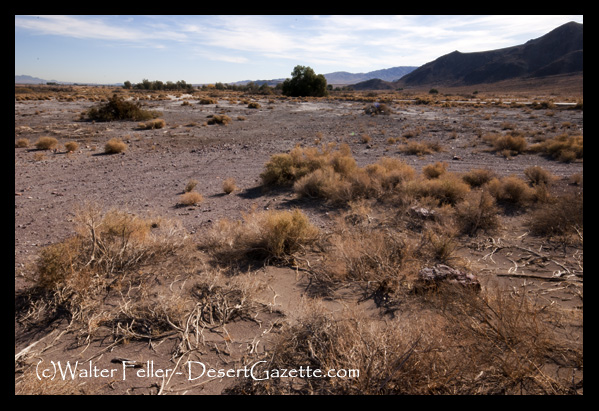
Huntington’s Station was the first trading post in the area, and although Heber Huntington only owned it from 1873 to 1878, it remained known as Huntington’s Station until the the railroad came through and renamed it Victor. The river crossing with a few modern exceptions as the Narrows Bridge, Rainbow Bridge, and the cement plant looks much the same today as it did in 1872 when Mecham built what has become Stoddard Wells Road.

Mojave River, Victorville
Mojave River at Huntington’s Crossing


Little Ellen Baley – Lost in the Desert Night

During this phase of the journey the wagon train was doing much of its traveling at night, owing to the great daytime heat of the desert and the long distances between water holes. At regular intervals during the night they would stop for a short rest. At one of these rest stops, eleven-year-old Ellen Baley, a daughter of Gillum and Permelia Baley, fell asleep and failed to awaken when the wagon train moved on. Somehow, she was not missed until the train traveled some distance. The poor girl awoke to find herself alone in the middle of a vast hostile desert. Filled with fright, she began running to catch up with the wagon train, but in her confusion she took off in the opposite direction. When she was discovered missing, her father and older brother, George, immediately rode back to where they had stopped. To their horror, she was not there! Captured by the Indians must have been their conclusion! Nevertheless, they continued their search by calling out the little girl’s name at the top of their voices as they rode back.Their efforts were soon rewarded when, far off in the distance, came a faint cry, “Papa, Papa.” Her father immediately answered and kept calling her name until he caught up with her.When reunited with her family and the other members of the wagon train, Ellen had a tale which would be told and retold by family members until the present day.

from –
Disaster at the Colorado
Beale’s Wagon Road and the First Emigrant Party

~ Charles W. Baley

I’ve been Working on the Railword

Train rolling through Mojave Desert
Southbound out of Barstow, Ca.


“BOOMER—Drifter who went from one railroad job to another, staying but a short time on each job or each road. This term dates back to pioneer days when men followed boom camps. The opposite is home guard. Boomers should not be confused with tramps, although they occasionally became tramps. Boomers were railroad workers often in big demand because of their wide experience, sometimes blackballed because their tenure of stay was uncertain. Their common practice was to follow the “rushes”-that is, to apply for seasonal jobs when and where they were most needed, when the movement of strawberry crops, watermelons, grain, etc., was making the railroads temporarily short-handed. There are virtually no boomers in North America today. When men are needed for seasonal jobs they are called from the extra board”

~ from Railroad Avenue, by Freeman H. Hubbard – 1945

Newberry Springs?

For a few months in 1883 when the Southern Pacific Railroad was being built, the Watson post office lived out its short tenure.  Watson was named Watson for Josiah Watson who was the postmaster. When the Watson post office closed the railroad named their station Newberry.  For a few months in 1899, the Newberry post office was reestablished then discontinued.  In 1911 the post office reopened and was named Wagner after Madge Wagner who ran it.  In July of 1919, the name was changed from Wagner to Water, who wasn’t a person but was named for the water that was pumped out of the ground for the Sante Fe Railroad’s use.  Then, years later in 1967, the name was changed from Water to Newberry Springs. No one is quite certain who Newberry was, to begin with, but it could either be for either one or both of two brothers named Newberry who lived near the springs, of which one was killed in a gunfight over water rights to the springs and ended up being buried on top of a hill not far from the springs. Or the name of the springs came from Dr. J.S. Newberry, a physician in the 1857 survey expedition led by Lt. Joseph C. Ives.

Newberry Springs, California

Newberry Springs