Bathtubs when first introduced in 1840 and laws were passed against their use due to safety reasons. Someone conceived the idea of a bathtub on wheels which visited homes by appointment. The idea worked so well these wheeled tubs were introduced in most of our larger cities and were quite a moneymaker. Most of them were built of steel and copper and about 7 feet long and nearly as wide. At least curtains on a frame gave some privacy.
(Capper’s Weekly, 1930)
The Playground
Where are They Now?


– b. unk. d October 12, 2013
Cause of death: eaten by red-tailed hawk.
The Railroad was Coming Through!
Hesperia, was initially purchased in anticipation of the railroad coming through. Investors stood to make a nice profit from not only the railroad, but in the real estate near by as communities grew.
Hesperia, Ca.
But the railroad was built to Mojave, where trains could easily be routed southward toward Los Angeles, or over the Tehachapis, then north to San Francisco. The Hesperia investment languished and then was passed on to others. The railroad came through much later, but it was not so much of a big deal then.
Back when Life was a Real Piece of Cake
Loving & Devoted Mother …
The following was written and recorded by E.C. Jaeger in 1922. I believe, although dated over 90 years ago, this behavior is just as relevant today as it was then, however, scaled down from our increasing intrusion into their ever-shrinking habitat:
If a female road-runner is approached when on the nest, she generally remains quiet until the intruder is right upon her; then she slips over the back of the nest and flies a short distance to safety, but where she can still see the unwelcome caller. At times she has been known to permit herself to be caught rather than forsake her young.

A member of the Cooper Ornithological Club (Mr. J. R. Pemberton) gives a most interesting report concerning the actions of a female roadrunner whose nest he found some ten feet above ground in a sycamore tree. As the observer began climbing up to the nest, the bird hopped to the ground.
“Immediately,” says Mr. Pemberton, “it began to squirm, scramble, and drag itself away across an open space and in full view. The bird was simulating a broken leg instead of a broken wing! The bird held its wings closed throughout the demonstration, though frequently falling over on its side in its enthusiasm. The whole performance was kept entirely in my view, the bird gradually working away from the tree until it was some thirty-five feet distant, when it immediately ran back to the base of the tree and repeated the whole show. I had been so interested up to now that I had failed to examine the nest, which, when looked into, contained five young probably a week old. When I got to the ground the bird continued its ‘stunt’ rather more frantically than before, and in order to encourage the bird, I followed and was pleased to see it remain highly consistent until I was decoyed to a point well outside the grove. Here the bird ran suddenly away at full speed and in a direction still away from the nest.”
Life in Harmony with Nature

Indians living in harmony with nature is an idealization to say the least. Life was hard and often got harder as evidenced by Olive Oatman’s observations of the Mojave Indians in the 1850s.
“One day I was out gathering. Chottatoe, when I was suddenly surprised and frightened by running upon one of the victims of this stupid, barbarous inhumanity. He was a tall, bony Indian of about thirty years. His eye was rather sunken, his visage marred, as if he had passed through extreme hardships. He was lying upon the ground, moaning and rolling from side to side in agony the most acute and intense. I looked upon him, and my heart was moved with pity. Little Mary said, ‘I will go up and find out what ails him.’ On inquiry we soon found that he had been for some time ill, but not so as to become utterly helpless. And not until one of their number is entirely disabled, do they seem to manifest any feeling or concern for him. The physician was called, and soon decided that he was not in the least diseased. He told Mary that nothing ailed him save the want of food ; said that he had been unable for some time to procure his food ; that his friends devoured any that was brought into camp without dividing it with him ; that he had been gradually running down, and now he wanted to die. O there was such dejection, such a forlorn, despairing look written upon his countenance as made an impression upon my mind which is yet vivid and mournful.”
~ Olive Oatman
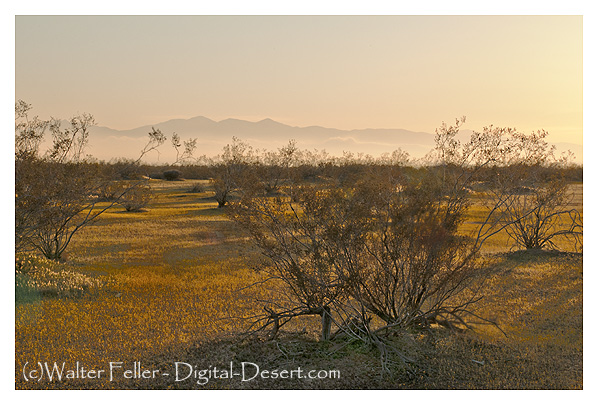
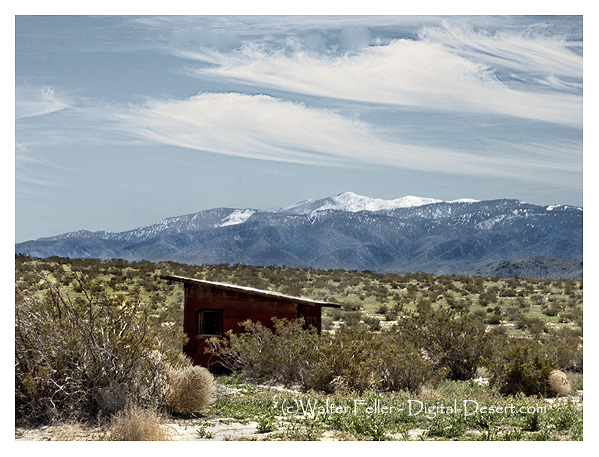
Cloud covered Mountains
The Empty Desert

I first went to the desert to experience what I thought would be sensory deprivation–after all, there was nothing there. It wasn’t like that though. I saw the wild geology, plants of all different kinds, animals fitting every niche, and human history, then even further back in time to the people without names. The closer I looked, the more I saw, and it all connected. These experiences filled my senses; to see the subdued pastels, to hear the cooing mourning doves, to smell the dust and creosote, to feel the rocky earth, and to even taste the gritty wax the dry heat of the desert left thick on my lips. Blazing days, frozen nights, campfires cooking up damned strong coffee. Red sunrises, hallowed and silent sunsets.
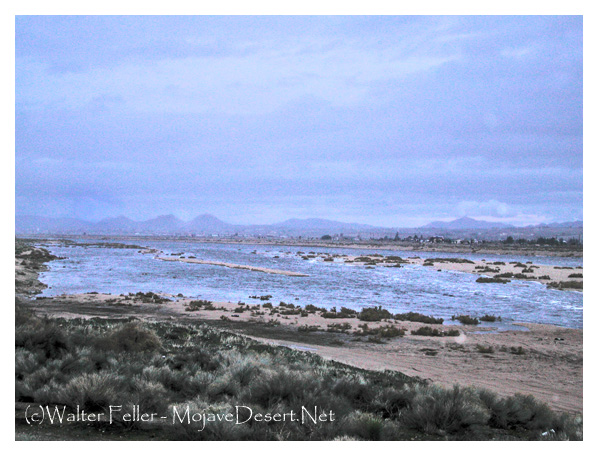
Hesperia Lake

Hesperia Lake:
http://digital-desert.com/a/hesperialake/
Differences
Sometimes the scenery appears to be the same– It looks like that here and there and over there. Look closer–this sameness is the differences. There are no gradual changes or blending. Everything is this or that. Hard contrast. Then, instead of becoming this faceless hole in our memory, we can become aware of our attachment to common reality.

Dolomite Ghost Town
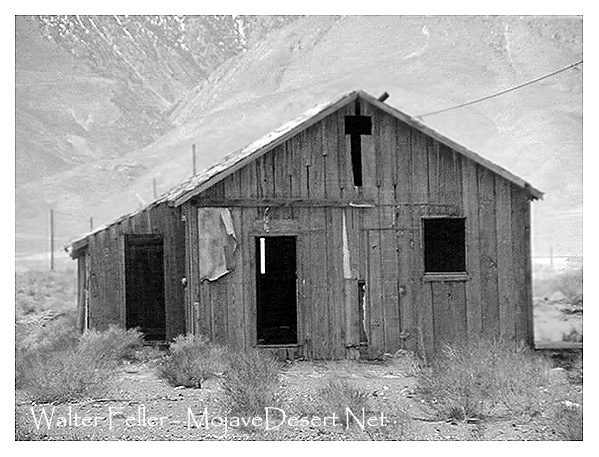
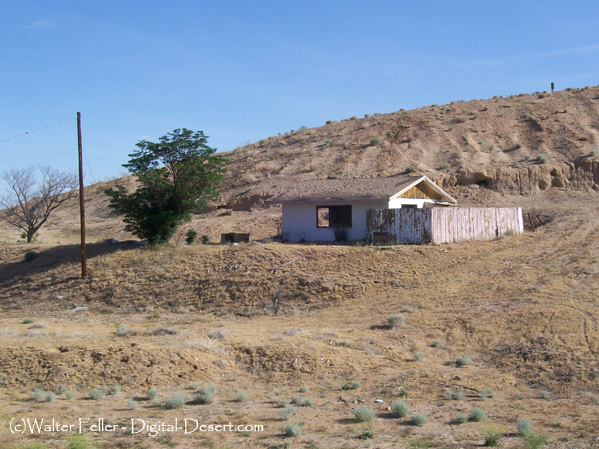
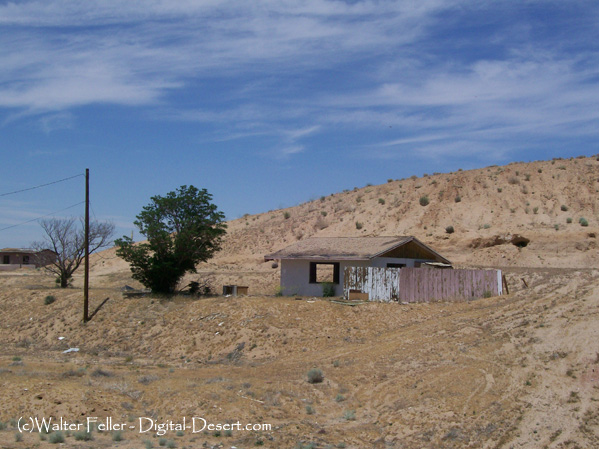
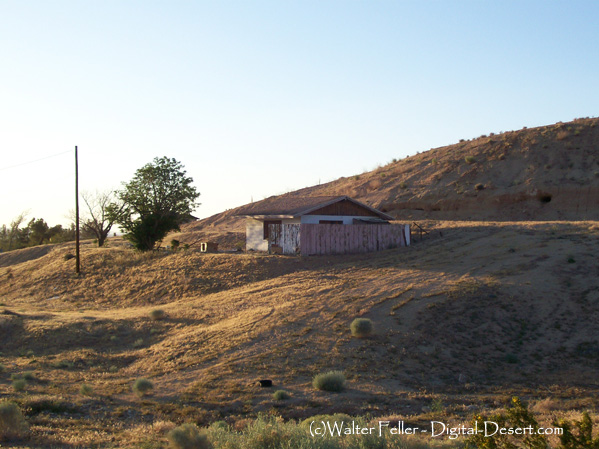
I suppose the good news is, is that I got this photo of a shack in the little ghost town of Dolomite. I suppose the bad news is that I shot it in 2001 with a low resolution camera. Then again, some good news is that I doubled the size of it and cleaned up a few rough spots on it with my fancy software. And I suppose the bad news is, is that for all my efforts, Dolomite isn’t an authentic ghost town. I’m finding out that it was built for a movie set. It is a bit of good news that the movie was Nevada Smith starring Steve McQueen, one of my favorite movies. The bad news is that I won’t e able to reshoot it because of circumstances beyond my control at the moment. That’s good because it was on private property. It could have been worse when I was caught trespassing the first time. The owner chased me down and started giving me hell for being on his property. So it was a good thing I told him I came in a few miles over and followed the base of the mountain shooting some other ruins while I went along. It was another good thing when he laughed at my little truck and said, “I wouldn’t think you could make it through there in that.” I told him I was just taking some pictures. He told me to “Have at it.”
At least I didn’t get shot.
Better Holes & Middens
Desert Woodrat
Neotoma lepida
Desert pack rat nests can be used by the same pack rat families for generations and generations.
This rodent is commonly known as the “pack rat” or “trade rat” named for collecting any shiny or metallic object it fancies. Its burrow is easily recognized by the rubbish littered about the entrance.
More about the wood rat:
https://digital-desert.com/wildlife/rodents/desert-woodrat.html
Local History — A 30 Second Story — Silverwood
This is Silverwood Lake. It is named after some guy named Silverwood rather than the silver wood that grows around the lake and Summit Valley. Before they could have the lake there had to be the dam. The dam in this picture is Cedar Springs Dam. Before the dam there was Cedar Springs. It was a small town. It was flooded to make the lake. Everyone moved out first. Some other stuff happened here before that.
The end.
Playas …
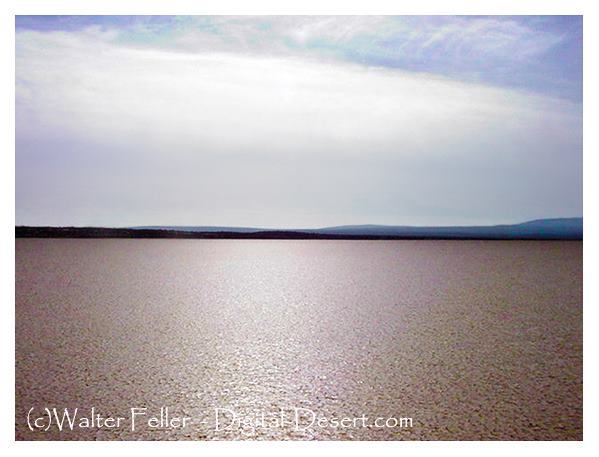
Playas, dry lakes, they hypnotize me. Flat and dry and scarred but still pure. Hardened earth and soft skies. An elegant monotony that locks in on whatever lobe in my brain it is that controls my fascination for seeking a niche, an edge, a flaw as my eye draws up to, in this specific case, a dark and slivered horizon. Few words. Clear and open thought. Appreciation. I clap my hands. The sound dissipates and the ever so slight vibrations go on endlessly.
Be Soft …
Flying Ford
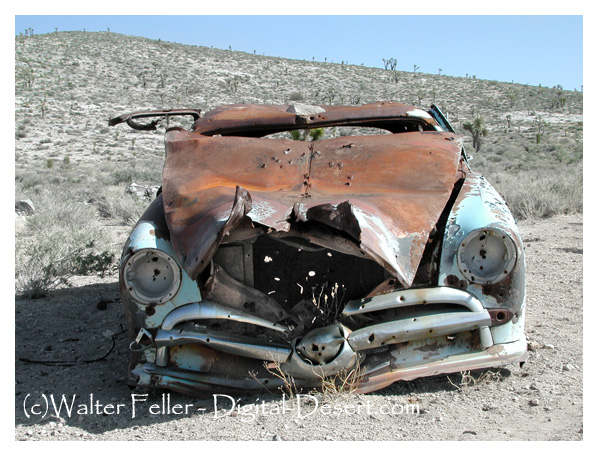
So the way it went is that the guys that were shooting at me fell over when I drove through just like I bowled a strike (and that’s why all the bullet holes are there). Some other guys started chasing me and I was going so fast that people said they could see my dust blowing in the wind for 32 miles. I come barreling down the road and the road turned and I didn’t so I went airborne over that there hill and landed in a dead stop right there where you see it. The old flathead engine was running so hard and fast still and afraid to do anything but go full throttle and it come bursting right out of the hole in the front you see and hurtled into space. About every 80 days the motor still flies by just a humming, spinning, and gleaming in the sun. I swear–true story.
~ Walter
Human Impact on the Mojave Desert
by Laurie J. Schmidt – EROS Data Center DDAC
What do you do when a fragile desert ecosystem turns into a recreational playground? Leonard Gaydos, Coordinator for the U.S. Geological Survey’s (USGS) Recoverability and Vulnerability of Desert Ecosystems project, and colleagues are using satellite data to develop tools that will help Mojave Desert land managers decide what recreational activities to allow and where to allow them. Specifically, the research team is studying vulnerability and recoverability of desert lands.
“Our goal is to create predictive models of the desert that land managers can use to forecast what is likely to happen to a specific piece of land, given its exposure to various types of disturbances,” said Gaydos.
The Mojave Desert encompasses 125,000 square kilometers in southern Nevada, western Arizona, southwestern Utah, and a quarter of California. Situated between the burgeoning cities of Los Angeles and Las Vegas, it is within a day’s drive of 40 million people.
“The Mojave Desert is increasingly viewed as a playground,” said Gaydos. “It now contains four national parks, with millions of people around the edges.” That wasn’t always the case, he said.
“The Mojave Desert was a place you went to get away from civilization. You didn’t have to worry about disturbing anyone or causing any harm,” Gaydos said. In fact, it was largely for this reason that the U.S. military established most of its training facilities there. “It was the last piece of open space in the continental United States where the military could conduct training and not disturb anyone,” Gaydos said.
But, the Mojave’s growing pains make an ideal case study for researching long-term effects of disturbances to desert ecosystems. Land managers are now faced with the daunting task of dealing with competing demands on the land, including impacts from all-terrain vehicles, motorcycles, military activities, and grazing livestock.
“It is incumbent upon the U.S. military, the Bureau of Land Management, the National Park Service, and other land managers to understand the effects of these disturbances on the land,” said Gaydos. “All compact the soil and disturb resources at the land’s surface.”
The project requires a combination of expertise, involving researchers who have worked extensively in adjacent arid land regions, such as southern Arizona, the Grand Canyon, and southeast Utah’s Canyonlands. “The project’s multidisciplinary nature means that scientists on the project team are learning from each other,” said Gaydos. “We have geologists out in the field looking for soil crusts and counting tortoise burrows — not traditional tasks for a geologist.”
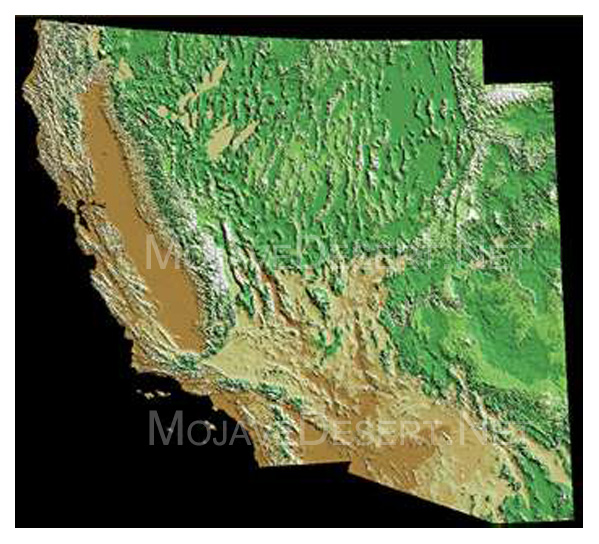
Shaded-relief model of the Desert Southwest (Image courtesy of the USGS Recoverability and Vulnerability of Desert Ecosystems project.
Remote sensing is one of the most valuable tools the team is using. “Satellite imagery enables us to look at the age and characteristics of a site’s surface geology, which is essential to understanding the rate at which that site will recover from disturbances,” said Gaydos.
The scientists use geologic maps created from Landsat 5 data, supplied by the EROS Data Center Distributed Active Archive Center (EDC DAAC) in Sioux Falls, SD. In addition, Landsat data have proved invaluable for identifying study unit boundaries when the team is working in the Mojave. The team also plans to use satellite data to examine dust movement in the desert, an important symptom of disturbance.
The researchers work with high-tech tools such as digital ortho-photos created by the USGS, and imagery from the Advanced Visible and Infrared Imaging System (AVIRIS). Digital ortho-photos are produced by applying corrections to aerial photos using an elevation model. “This process enables us to remove distortions from aerial photos so that they scale correctly, which helps us interpret what we’re seeing,” said Gaydos.
The multi-band capability of the AVIRIS sensor enables computer enhancement of land features, a vital part of the geologic mapping process. “This application of AVIRIS data is still experimental, but it shows lots of promise in mapping the surface geology of the Mojave Desert,” said Gaydos.
These tools have greatly contributed to some of the project’s key findings. First, the research team found that under most circumstances, land seems to recover faster in the years immediately following the disturbance than in later years. In addition, not all areas recover at the same rate.
“The good news is that the desert seems to recover faster than earlier models predicted. The bad news is that it still takes the land a long time to return to its original state, and, in some cases, it may never be exactly what it was before the disturbance occurred,” said Gaydos.
As an example, Gaydos described one of the project’s test sites that lies near an old railroad line built in the early 1900s. For the past 50 years or so since the railroad was abandoned, a berm has acted as an artificial dam for surface processes, such as erosion and runoff. By digging trenches on the slope side of the railroad line, team members measured nearly a dozen flood events. Successive flash-floods rinsed sediment down and built up the surface nearly a meter. “This tells us that we’re dealing with a very dynamic system in the Mojave,” said Gaydos. “At various intervals, flood events wash the sediment down, the plants adapt, and the desert renews itself.”
Land management ranks are also subject to renewal. To keep changing land management and restoration staffs apprised of current findings, Gaydos and his team must maintain regular communications with those in the field.
Sustaining investment is critical, according to Gaydos, because the project still has a way to go. “In the past, the Mojave Desert has been benignly neglected,” he said. “People haven’t worried about it much — it’s not Yellowstone or the Everglades, or any of the places that tend to come to mind when people think of protecting the environment.”
Fortunately, those values seem to be changing, and the desert “playground” is now deemed a valuable resource.
Glossary Update – Flash Flood
The Thousand Year Ballet
Migration- plants migrate. Plants are always looking for ideal conditions, conditions that help them live longer and better. This is a condition of life. Everything living does this. Inch by inch, foot by foot, generation after generation–plant populations move, march on toward better lives in more conducive environments. They adapt. They evolve. They move in the gradual changes of long-term weather patterns. We may not see it in our lifetimes, but we can in the histories find evidence of, and compile; this used to be here, that used to be there, relict populations remain if any. A seed grows here but not there, and a seed will sprout on this side and not that side. A slow dance extending much longer than we can personally experience, but a dance indeed.

Life!
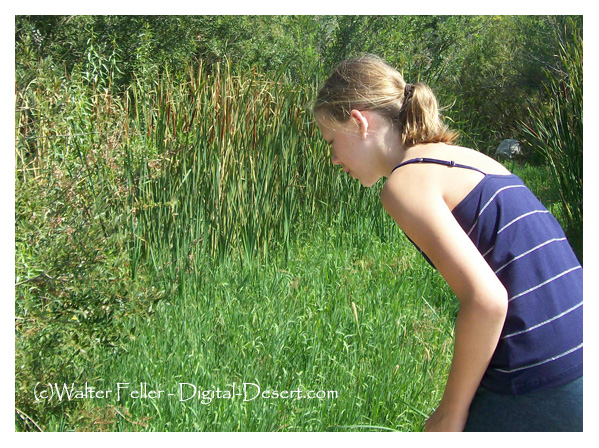
11-year-old Kass, a desert girl born and bred, looks into a natural stream of water (Cajon Creek) for the first time in her life. She was amazed that there was so much life going on right in front of her–everything she could see was living!

She pointed this all out to me as it was happening. She has such a wonderful sense of Nature. I’m so fortunate to have experienced this with her.
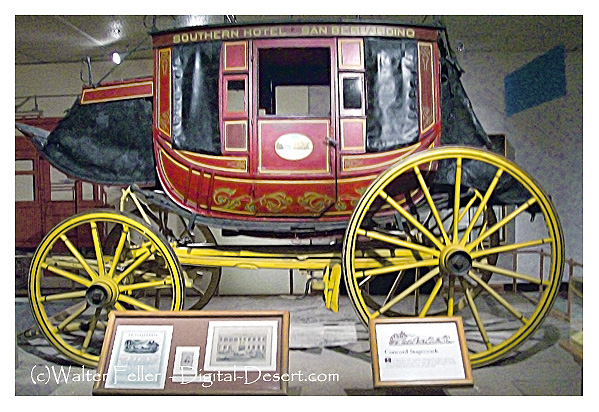
Tips for Stagecoach Travelers
from the Omaha Herald, 1877
The best seat inside a stage is the one next to the driver. Even if you have a tendency to seasickness when riding backwards — you’ll get over it and will get less jolts and jostling. Don’t let “sly elph” trade you his mid-seat.

(L.A. Co. Museum)
In cold weather, don’t ride with tight-fitting shoes, or gloves. When the driver asks you to get off and walk, do so without grumbling, he won’t request it unless absolutely necessary. If the team runs away — sit still and take your chances. If you jump, nine out of ten times you will get hurt.
In very cold weather, abstain entirely from liquor when on the road, because you will freeze twice as quickly when under its influence.
Don’t growl at the food received at the station — stage companies generally provide the best they can get.
Don’t keep the stage waiting. Don’t smoke a strong pipe inside the coach. Spit on the leeward side. If you have anything to drink in a bottle, pass it around. Procure your stimulants before starting, as “ranch” (stage depot) whisky is not “nectar.”
Don’t lean or lop over neighbors when sleeping. Take small change to pay expenses. Never shoot on the road, as the noise might frighten the horses. Don’t discuss politics or religion.
Don’t point out where murders have been committed, especially if there are women passengers.
Don’t lag at the wash basin. Don’t grease your hair, because travel is dusty. Don’t imagine for a moment that you are going on a picnic. Expect annoyances, discomfort, and some hardships.
A Photo Tip
Quick Study
Cyrena Dustin Merrill – Part VI
Philemon’s mother hearing that we were coming started out to meet us but got on the wrong road, missed us, and had to walk back a long distance — we were about two weeks making the trip and the worry of it all must have told on me for when my sister-in-law first met me she said “is this you, Cyrena, or your ghost?”
About a week after I got back, my two children were taken sick with chills, then I was sick; then baby took croup and only lived about 12 hours, dying on the sixth of September.
I let father and mother Merrill take my fitout (of wagon, oxen etc,) and they went on with the first company that went to Salt Lake in 1847, but I stayed here at Kanesville until my husband’s return on December 11, 1847 from Battalion.
He spent his time in getting land warrants for the Battalion Boys and assisting Brother Young to get emigrants across the plains.
Here on September 10, 1848, our third daughter, Melissa Jane, was born.
In the spring of 1849 Brother Young having sent our teams back Salt Lake we fitted up and crossed the plains. Now we were really going to Zion and as our hearts were filled with gratitude to our Heavenly Father for His love and protecting care, we were enabled to endure all our trials with cheerful fortitude. Our faith was strong — we loved each other and lived in unity and we were blessed abundantly, and our souls often rang out on the prairies.
While passing through the Rockies we encountered severe snowstorms in many of our cattle perished, but again the Lord helped us, for father Merrill sent a team with a nephew to assist us into the city of Salt Lake.
Our first stopping place was in Salt Lake City where we built a log cabin in the Southwest or 19th Ward stayed here until 1857.
On the Big Cottonwood 7 miles from Salt Lake City, our first Utah baby, our second boy, Morgan Henry was born on February 17, 1850. And when he was three weeks old we moved into the 19th Ward of the city and my husband again left me alone with my little ones.
Houses then were scattered and the measles broke out among the Indians and they would rush past our cabin howling and screaming — run and jump into the warm springs and then take cold and die — then others would bewail and screech — and at all times of the day or night their howls or mournings rent the air and my hairs would stand on and from fright; the only times I ever slept that night was one of my brothers-in-law would come up from Cottonwood to stay a while.
Philemon had gone back to the Platte River to keep the ferryboat.
— continued —Snake Bite — Don’t Make it Worse

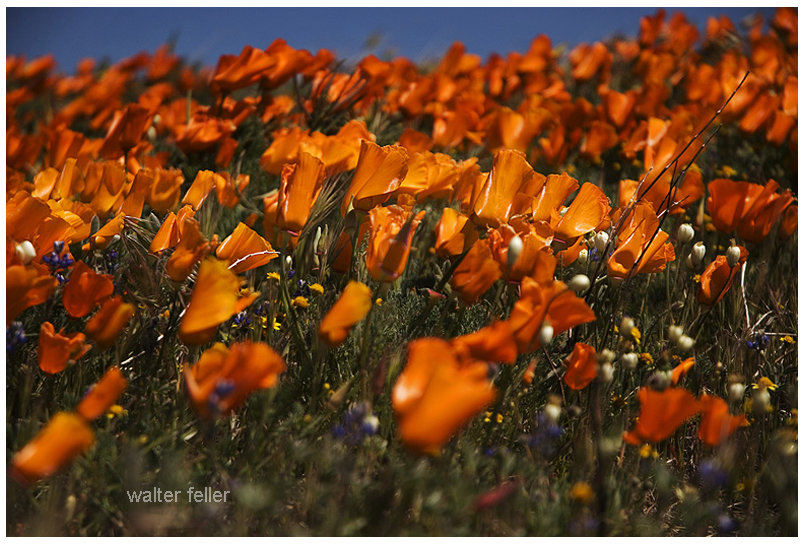
A description of events in one day in April of 2010 while I worked as a volunteer at the California State Poppy Reserve in Lancaster, CA.
I was working the trails one hazy midday when two very excited young gentlemen came running toward me and told me that their uncle had stepped on a snake and it had bit him. The uncle, limping badly, looked pasty-pale and with his friend and brother made their way into the visitor center after once again telling me the man had stepped on a snake. The victim’s brother (as I found out later) while closing the door whispered to me, “He didn’t step on it, he kicked it to get it out of his way.”
First, I inspected the wound. Yep, it was a snake bite hole. Next, I asked if he knew what kind of snake it was, or what it may have looked like. He told me, “It looked like a snake. I told you that already.” I bit my lip. He was regaining color.
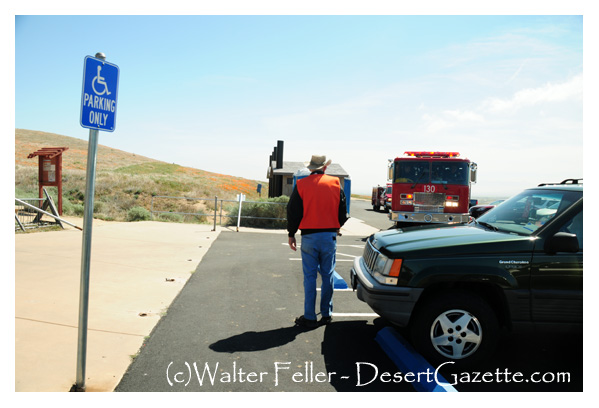
Since I’m not a doctor and I felt the patient was being a jerk I decided a medical professional would have to take it from this point. I called 911. It takes about 20 minutes or so for emergency response vehicles to get from Lancaster to the reserve. The dude was looking better and looking at me as if he expected me to suck the poison out of his leg. “Not my job,” I thought. There were other volunteers there that were far more capable than I, so I went out with my buddy Morris (Volunteer of the Year) to stand in the parking lot.
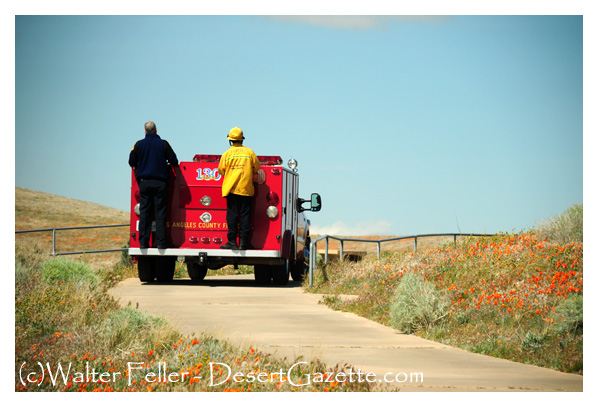
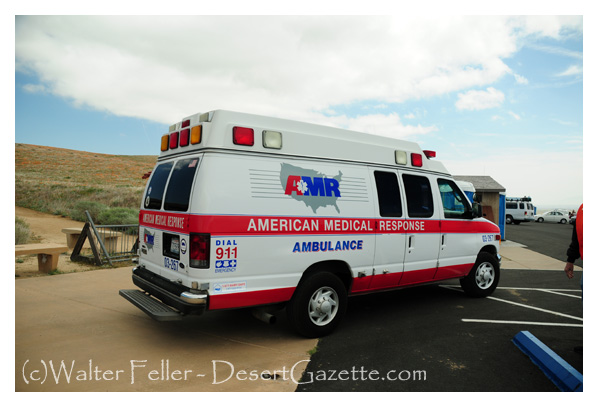
The fire truck came first with a support vehicle, whatever they call the service truck that follows. The fire truck couldn’t make it up the sidewalk to the visitor center, but the smaller truck could. I wanted to ride on the back too, but I didn’t ask. It looked like fun.
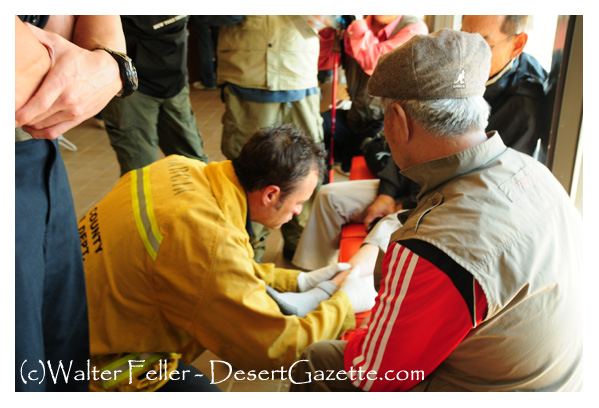
The paramedic rushed into the building with about a dozen other personnel and did a triage-type-thing. Assessing the wound he confirmed my suspicions that it was a snake-made-hole in his leg.
Next, the helicopter came. There was no place to land so it went away. That would have been so cool to see the guy get a ride in that. I would have asked if I could go with them, but I would have had to walk back.
So they took him away in an ambulance.
One of the guys with him asked me, “Where did they take him? I said, “I don’t know. I’m not from around here. I live about 70 miles away.”
My shift was over then. So I went to my brother’s house to stay the night with him. I hope the snake is alright. I can’t see how the guy with his little-skinny-toothpick-legs could have kicked it hard enough to hurt it. Good example though. Nobody else kicked a snake for the rest of the season. One of my best times ever, so far, yet.
Simply Nature
It is simple, really; the wind storms bring dusk early to the high desert. The airborne dust hastens the sunset, and the sunset goes deep and passionately purple. the wind rests and the day is over. Equilibrium.
The desert wind has played its joke.
Move forward into the forever blue of the “Everything.”
A long night to hunt or be hunted.
By the time the sun has raced around the earth and rises, the game has changed ever so slightly, and some desert creatures will be dead, and some will be fed.
~ W.Feller.
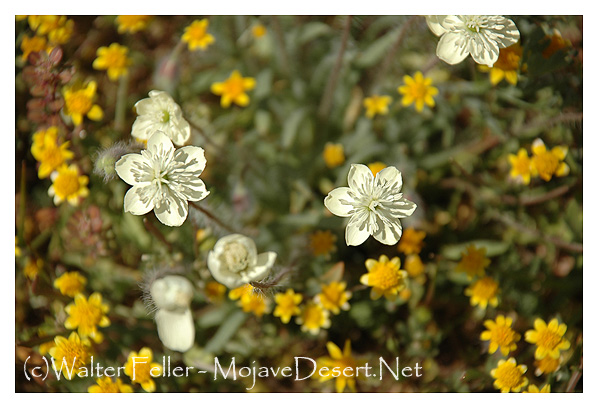
Cream Cups – Wildflowers
Update to cream cup in the wildflower guide:
Flowering early-late spring. Open, grassy areas with loose or disturbed soil or following burns; 0-1000(-2000) m; Ariz., Calif., Nev., Oreg., Utah; Mexico (Baja California). …
Cyrena Dustin Merrill – Part V
The Call for 500 Men
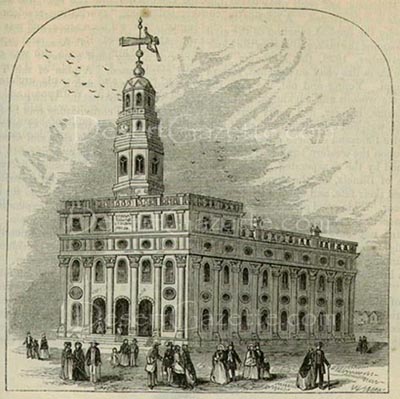
During 1845, although we were preparing to leave Nauvoo for the Rocky Mountains, they were pushing the work on the Temple and on May 24 the walls were finished and the Apostles administered to hundreds of the people — the services often continuing all day and all night. We received our endowments in the last of December going through the Temple at night.

Now as the mob it said “we will still drive all the Mormons into Nauvoo and all Nauvoo into the Mississippi,” preparations were made immediately evacuating the city and on February 6, 1846, my husband left with the first K guards to guard the records across the river, and went on to Garden Grove, leaving me with my little ones in Nauvoo. When he came back near the last of April with a team, our second daughter Lucy Cyrena, was three weeks old — she, having been born on April 7 — and taking only our bedding and clothing — leaving everything else in the house we went by wagon to Mount Pisgah.
Authorities held counsel and concluded to move on, after putting up some huts which could be used by those coming later.
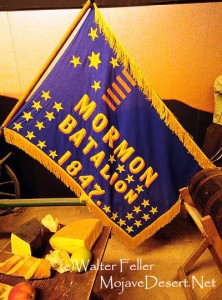
When within a few miles of Council Bluffs we were met by an United States officer to enlist men for the Mexican War. Coming to a halt Brother Brigham called for 500 volunteers. On July 16 the troops were mustered, my husband being among the number, thus we were left without our natural protectors and as this took our stoutest and best the way much hard work was thrown on the women and the aged. I had only one week’s provisions on hand.– But our faith was strong and Brother Brigham would lead us on. After they had been gone three days some men returned from the Battalion and started to the camps that Capt. Alan had sent them to gather up 50 families of the Battalion Boys, and they could travel with their husbands to California as the government would pay all expenses.
At first I did not wish to go but being over persuaded, I joined the company to follow my husband. My driver was Monroe Frick, a boy of 14 who was such a good kind boy. I arrived at Fort Leavenworth about August 1, 1846.
The joy of once more meeting my husband was of short duration for he could not consent to me traveling with them with my little children and the young babe; so after putting up a wagon with 18 months provisions and to yoke of oxen, Monroe and I started back over that lonely road of 200 miles to the camp of Israel. This was done by the advice and counsel of Brother P. P. Pratt.
Philemon went a day’s journey with us and when he left us in the morning was the hardest of all my trials — we had to travel through Missouri whose swamps were full of malaria, and several times we came to places where the rain had washed out the road and we had to unload our flour and provisions, get the wagon across, then carried the things over and reload. It seems a miracle that we ever succeeded in reaching Winter Quarters, but in God was my trust and he protected us and cared for us.
Zigzag
Interesting how a zigzag of light against a shadow will catch your eye while you look away from the low sun. Anticipation, is paramount; the shadows roll over the mountain canyons and ridges quickly. Observe it then. Blank everything else out and don’t look away. What you will see will never be the same again. Don’t miss your moment!